
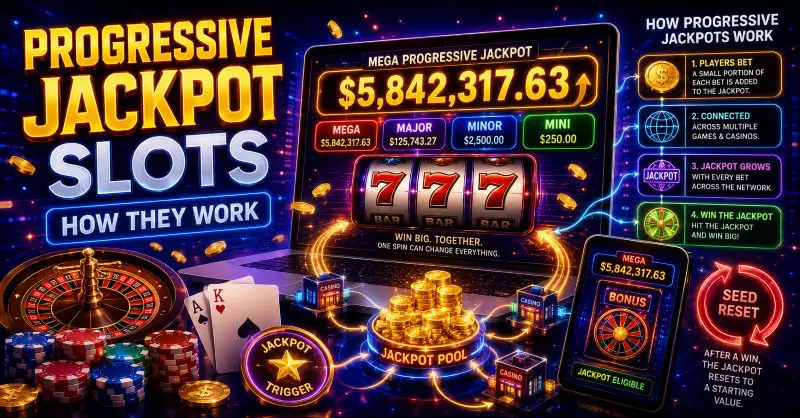
There’s a type of display you may have seen scrolling through a hundred times without ever stopping – a progressive jackpot counter increasing in real-time to show something like $4,382,910 and increasing in value by a few cents every second. In effect, this is a progressive jackpot slot machine doing precisely what it was designed to do. It’s likely the only element in online gaming that can transform a $1 bet into a legitimate seven-figure story.
The question of whether or not that is an achievable outcome for you is a separate question that this guide addresses directly. As such, progressive jackpot slots differ fundamentally from a traditional slot machine. While a traditional slot machine offers a fixed jackpot that awards, say, 5,000x the amount of your bet irrespective of when you play; progressive jackpot slots utilize a different mechanism. Each progressive jackpot slot contributes a portion of every bet made by every player into a jackpot pool that continually increases in value until someone wins it.
Afterward, it returns to its original value and begins increasing again. The mechanics used to create progressive jackpots are the only reasons why these types of games can generate massive jackpots that become the focus of casino marketing. Additionally, understanding the source of funding behind these games is important to consider prior to depositing funds into a progressive jackpot slot machine.
What are progressive jackpot slots?
In the simplest terms, progressive jackpot slot machines collect a percentage of every wager, usually ranging between 1% to 3%, and add those funds to a jackpot pool above and beyond the standard payouts of the game. The largest prize offered by a standard slot machine is determined by its pay table and does not change.
On the contrary, the largest prize offered by a progressive slot machine is constantly changing due to every spin played anywhere in the world utilizing the same game. There are various structures utilized for progressive jackpots based upon how contributions are collected. Standalone progressive jackpots collect contributions solely from players on that one machine, which typically results in slower growth but allows the player to win the entire jackpot.

Local progressive jackpots link multiple machines together at a single casino or platform. Network progressive jackpots connect identical games at numerous (dozens to hundreds) casinos worldwide. This is how progressive jackpots can grow into tens of millions of dollars.
How progressive jackpots increase and how they are funded
Each time a player places a spin on a progressive jackpot slot machine, a portion of the bet is removed prior to determining the possibility of winning a line and added to the jackpot pool. This removed portion is referred to as the “jackpot contribution.”
Players are usually unaware of this deduction since it is included in the return-to-player mathematics (i.e., RTP), rather than presented as an additional charge. For example, if a game offers an RTP of 96% and utilizes a 2% contribution towards each bet placed into the progressive jackpot, both percentages are combined to create the differential between the RTP of the base game and what would have been available on a non-progressive version of a similar game.
The first step in creating progressive jackpots is establishing a “seed” or “jackpot seed,” which represents the initial value assigned to the jackpot immediately after it is awarded to a player. For instance, a Mega Moolah progressive jackpot may be seeded at approximately $1 million to $2 million, then begin accumulating funds from bets placed on all participating casinos operating that game. Smaller progressive jackpots (e.g., local or standalone) may be seeded at hundreds or thousands of dollars.
The distance between seeding and ultimate winnings depends on how many players are contributing and how long it takes for the conditions necessary to award the jackpot occur. A quiet standalone progressive in a low-traffic casino may take months to achieve significant growth beyond its seed. Conversely, a highly connected network progressive with thousands of players placing spins at the same time can grow by five figures in less than twenty-four hours. Once the progressive jackpot is awarded, it returns to its seed value and begins accumulating funds once again.
Triggers: How you win
As previously stated, this is where progressive jackpot slots diverge greatly among themselves, and it is beneficial to understand before attempting to sit down and expect a certain mechanic. Many games employ random triggers for their jackpots; therefore, regardless of what symbols appear on your reels, the game’s random number generator can award the jackpot.
Other games require specific combinations of symbols (for example, three jackpot symbols appearing on adjacent reels), possibly only during a bonus round or during specific game modes. Lastly, many games use bonus rounds to determine which tier of the jackpot you will receive. For instance, Age of the Gods (a Jackpot Series developed by Playtech) employs a bonus-round trigger to send qualified players into a jackpot wheel that randomly assigns the tier of the jackpot.
Divine Fortune (developed by NetEnt) employs a mix of bonus-round triggers with falling wilds respins, potentially allowing players to earn the jackpot on occasion. Hall of Gods employs an equivalent bonus-round method as Divine Fortune; therefore, obtaining three bonus symbols allows players to access the wheel that determines the tier of the jackpot.
Why Mechanics Matter
Mechanics matter practically because they affect your chances of winning. Random Triggers are commonly found on network progressive jackpots (such as Mega Moolah); therefore, theoretically fire on every spin with an incredibly low probability contained within their mathematical formulas regardless of the bet size on some versions; however, most modern progressives necessitate maximum bet requirements to qualify for top-tier prizes; therefore, smaller bets may still contribute toward the pool without having the opportunity to ultimately win the maximum prize.
Tiered Jackpots and Games Built Around Them
Many progressive slots provide more than one prize; instead, they present four distinct levels of prizes – Mini, Minor, Major, and Mega – each with its own seed value and growth rate. A typical four-tier progression model provides:
- Mini Tier: Seeds around $10-$20; Hits often; Sometimes multiple times per session on busier networks.
- Minor Tier: Seeds around $50-$100; Hits periodically; Frequently within a single sitting if you are continuously playing.
- Major Tier: Seeds around $10,000-$50,000; Hits occasionally; Occasionally weekly across larger networks.
- Mega Tier: Seeds around $500,000-$1 million; Hits rarely; May go months between wins on larger network titles.
Operators also employ daily jackpots, hourly jackpots, and what are commonly referred to as must-drop jackpots. Must-drop jackpots guarantee a payout before reaching a predetermined cap (usually by a specified time of day). Daily and Hourly jackpots provide players with some insight into when they may next see a payout; However, there remains complete randomness surrounding when the next winning spin occurs.
Mathematics Behind What You Are Playing Against
While marketing campaigns for progressive slots highlight their ability to produce massive jackpots; however, the probabilities associated with winning such jackpots are extremely low; often significantly lower than achieving smaller wins on non-progressive slots employing similar themes.
Due to the fact that a substantial fraction of each player’s expected return on investment is directed into the jackpot pool rather than distributed throughout numerous smaller wins as part of the base game’s overall RTP; thus, progressive slots tend to operate with higher volatility and fewer opportunities for smaller wins compared to their non-progressive cousins.
A game may advertise an overall RTP of 94%; However, a considerable percentage of this overall RTP is provided as payment to the player who ultimately earns the top jackpot. Therefore, if you fail to earn this top prize (which statistically speaking, applies to almost every player); Your actual average return on investment will be closer to the base RTP, often significantly lower than the overall RTP advertised by the game developer.
This disparity exists due to pooled jackpot mathematics; Thus providing an accurate representation of expected return on investment; however, providing little benefit to individual players except for occasional major wins. Volatility further exacerbates this issue. Dry periods lasting weeks are commonplace on progressive slots featuring high volatility; And this is prior to accounting for potential earnings from any subsequent jackpot award.
Expectations for Beginners
For beginners entering this space of online gaming, the honest expectation is that you are betting for lottery-style outcomes rather than pursuing steady incremental gains. Progressive slots trade frequent wins for possible large paydays; And viewing an extended session spent playing Mega Moolah or Divine Fortune as an intelligent bankroll management strategy misrepresents what these games were created to accomplish. In essence, playing progressive slots closely resembles purchasing a scratch-off ticket with better graphics, rather than intelligently managing your bankroll on a low-volatility base game.
Evaluating Eligibility Rules Prior To Beginning
It is worth spending two minutes evaluating eligibility rules prior to beginning play since several network progressive jackpots silently restrict eligibility for large jackpot awards unless you are playing at or near maximum bet; Therefore allowing players betting at minimal table limits to place countless hours worth of bets into the pool while never having the opportunity to compete for large awards even if triggering events occur.
Capped vs Uncapped Jackpots
Some operators implement caps on their jackpots while others leave theirs uncapped. Capped jackpots ensure that they will eventually pay out (prior to exceeding an established limit) while uncapped jackpots continue growing indefinitely until they are awarded. Understanding whether or not you are playing a capped or uncapped jackpot will help inform your expectations regarding timing.