

Ask a group of slot machine players what RTP represents, and many of them would probably give you a good guess. Ask about Volatility, and you’d likely hear a few positive responses. However, ask about hit frequency, and most would look at you in shock, or perhaps someone would simply assume hit frequency refers to RTP.
That’s unfortunate, since hit frequency is probably the best measure of how a slot machine performs from spin to spin relative to the Two other metrics. Hit frequency helps explain why one slot machine can entertain you for an hour on a limited budget, while another slot machine can consume that same budget in twelve minutes, although both claim “96% RTP” on the info screen. Once you comprehend hit frequency, you won’t be shocked by your sessions anymore, and that in itself is worth a great deal.
What is slot machine hit frequency?
Slot machine hit frequency refers to the number of spins of a slot machine where any payout occurs. This is the entire explanation. Hit frequency does not take into account the size of a win nor whether it exceeded your bet. A win of 0.2x your bet constitutes a hit, as does a win of 250x your bet. Therefore, if a slot machine has a hit frequency of twenty-five percent, it follows that in a relatively large number of spins (a million+), approximately one quarter of those spins will generate a win. Other terms for hit frequency include slot hit rate and slot win frequency; they all represent the same metric.
In that preceding sentence lies a significant portion of the weight. Hit frequency is an attribute of the game’s mathematical model: specifically, the reel strips, the distribution of symbols used in the game, the pay table and features provided by the slot machine manufacturer, and tested by companies such as GLI and iTech Labs. Thus, hit frequency provides insight into what takes place in thousands or millions of spins; it does not provide information regarding what will occur during your next fifty spins; that is addressed later.
Calculating slot machine hit frequency
Hit frequency calculation is a straightforward process:
Hit frequency = (winning spins ÷ total spins) × 100
For example, suppose you played 1,000 spins and experienced 270 winning spins. Your hit frequency would be equal to 270 ÷ 1,000 = .27 or a 27% hit frequency. Using the inverse of your hit frequency will provide you with the approximate average distance between successive hits: 1 ÷ .27 ≈ 3.7 spins.
Developers do not determine hit frequency using this method. Rather, they accurately compute it via exact methods based upon the design of the slot machine’s reel configuration (the strip layout). As a player, the only viable method available to you to estimate the hit frequency for a particular game is to track your own spins, especially if the manufacturer did not provide a specific value. Unfortunately, this is where most users’ “hit frequency calculators,” particularly homegrown versions, fail miserably due to sampling issues discussed below.
The uncomfortable statistics
If we assume that the actual hit frequency for a game is 27% and we record our own spins to establish an estimate of the hit frequency, there is a reasonable possibility that the resulting estimates based on a sample of 300 spins will vary significantly – i.e., approximately 5-6 percentage points in either direction – at a typical confidence interval. Furthermore, increasing your sample size to 1,000 spins reduces that variability somewhat – i.e., to approximately 6-8 percentage points — still not sufficient to allow you to distinguish reliably between games having hit frequencies of 26% versus 28%.
A few years ago, I recorded hundreds of spins on two slot machines whose behavior seemed dramatically different; I noted that one had “many more hits.” After I accumulated data for several thousand spins for each title, the performance difference largely evaporated. Small samples lie convincingly, therefore, when recording your own play; record every spin; record every payout regardless of magnitude; and do not rely upon fewer than 1,000 spins for estimates.
Hit frequency v. RTP
Most of the confusion regarding the topic exists here. RTP (return to player) denotes the long-term ratio of total wagers made on a slot machine to total wagers paid out on that slot machine. For instance, a 96% RTP indicates that in excess of millions of spins, a slot machine should pay out $96 for every $100 placed in bets, leaving a house edge of 4%. Hit frequency conveys how frequently a slot machine pays out. There are many potential ways that a pair of slot machines can have identical RTP values with greatly disparate hit frequencies since the RTP can be returned as numerous small winnings or merely a handful of larger ones.
A useful relationship exists between hit frequency and RTP:
Average win per hit ≈ RTP ÷ hit frequency
Suppose we consider two hypothetical games that both exhibit a long-run RTP value of 96%. One game exhibits a hit rate of forty percent and thus has an average payout per hit value of about $0.96 ÷ 0.40 = $2.40 per bet. The second game exhibits a hit rate of eighteen percent and hence has an average payout per hit value of about $0.96 ÷ 0.18 ≈ $5.33 per bet. These two slot machines are returning the same proportion of total wagers in the long run; however, they offer vastly different experiences. Game A dribbles along and offers infrequent, small wins. Game B remains dormant for extensive periods of time prior to providing substantial payouts.
Again, please note that the average conceals considerable detail. For example, in game b’s case, the “average win value” of $5.33 may consist of many occurrences of $0.50 and $1.00 wins accompanied by an occasional 200x Bonus to raise the average value.
Hit frequency v Volatility
Volatility (also referred to as variance) reflects how unevenly payouts are dispersed within a slot machine; i.e., how large the swing factors are in payouts. Hit frequency measures how often a payout (of any size) occurs in a slot machine. Typically, hit frequency and Volatility move in opposite directions; however, as illustrated with examples throughout this article, there are instances where hit frequency and Volatility do not necessarily move inversely.
Low Volatility games tend to have higher hit frequencies
Games exhibiting low Volatility typically have more frequent payouts than high Volatility games. On average, low Volatility games provide more frequent payouts (smaller payouts) than high Volatility games; consequently, low Volatility games typically require less time to recover from a series of losses than high Volatility games.
High Volatility games tend to have lower hit frequencies
Conversely, games characterized by high Volatility tend to have fewer payouts than games characterized by low Volatility.
Why frequent wins are not always profitable
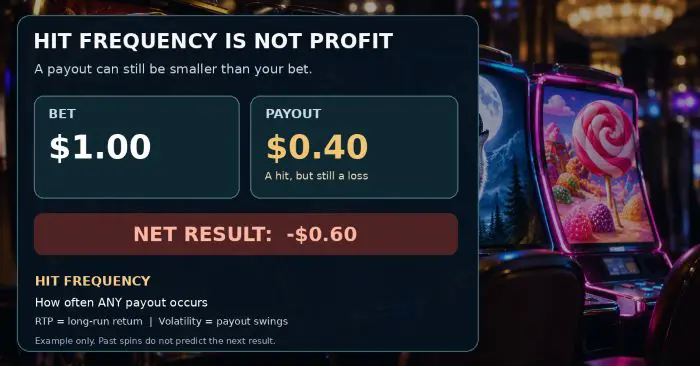
Hit frequency can be misleading. For example, let us assume you’re betting $1 per spin on a twenty-line slot machine. You draw three consecutive identical symbols on one line and receive $0.40 in winnings. The reels light up; the counter increments; and there is an auditory signal indicating success. You just lost sixty cents!
Research conducted by gaming researchers at the University of Waterloo and others describes this type of outcome as losses disguised as wins or LDWs. Research has demonstrated that players respond physically and emotionally to LDWs similar to winners; and research has demonstrated that players typically perceive LDW-rich sessions as more enjoyable than they actually were. Consequently, games exhibiting high hit frequencies with minimal stakes are perceived as being liberal yet quietly devouring your bankroll through their normal house edges.
Therefore, when evaluating a slot machine’s hit frequency, attempt to divide that figure into two components: hits generating greater than your bet plus hits generating less than your bet. The majority of games display neither component separately in their information screens; however, many games’ pay tables will indicate which low-paying symbols appear on games featuring multiple pay lines and are thereby considered losses disguised as wins.
Dry spell math nobody tells you
Another important aspect to consider is dry spells, or losing streaks, when playing slots with different hit frequencies. Based on our previous discussion concerning hit frequency and probability theory, we know that with regard to any single spin within a slot machine offering thirty-three percent hit frequency, there exists a seventy-seven percent chance that spin will lose money. The probability of experiencing ten consecutive losing spins is equivalent to multiplying seven-seven percent (i.e., seventy-seven percent) times itself ten times which yields a probability roughly equivalent to four-point-three percent (i.e., 4.3%).
Although this appears to be a rare occurrence statistically speaking (four-point-three percent), with respect to any fifty-five-hundred spin session you will experience many opportunities to encounter sequences consisting of ten consecutive losses. Therefore, it is virtually guaranteed that at some point during any fifty-five-hundred spin session you will observe at least one sequence containing ten losses.
To illustrate this concept further: if we reduce the hit frequency from thirty-three percent to twenty percent and recalculate the probability of encountering ten consecutive losing spins, we obtain roughly eleven percent (11%).
Pay lines & Bonus features impact hit rates
The game mechanics involved with slots impact hit frequency substantially, and in some cases are easily misunderstood.
More ways to win means more hits
Generally speaking, more ways to create combinations leads to more hits. Slots employing 243 ways to win or 1024 ways to win typically offer higher hit frequencies compared to traditional ten-line slot machines since adjacent reel positions may yield a combination.
Cluster pays & Megaways slots use their own systems
While cluster pays and Megaways employ unique systems relative to traditional slots, their underlying logic is essentially consistent: more ways to create combinations results in more frequent (and generally smaller) payouts.
Older slot machines featuring adjustable number of active paylines
In older slot machines allowing players to select active paylines from zero upwards (typically ranging from zero to fifteen or twenty paylines) adding additional paylines increases your hit frequency per spin. Nevertheless, your total bet increases equally with additional paylines added; and rtp is nearly always identical per line activated.
Modern online slots feature fixed paylines/ways
Fortunately for players today, most online slots utilize fixed payline/ways configurations, so enabling changes in activated paylines is no longer relevant.
Buying bonuses skips the base game
When buying bonuses, you bypass the base game entirely so base game hit frequency becomes irrelevant for these purchases. By doing so you are trading many small hits for one big hit with potentially increased Volatility associated with that purchase option. Additionally, some manufacturers apply differing RTPs when purchasing a Bonus versus playing normally; therefore, verify game rules prior to making assumptions on RTP equivalence.
Finding published slot machine hit frequencies
Unfortunately, there isn’t an absolute answer to this question — except it rarely ever happens.
Disclosing RTP is mandatory for regulated jurisdictions; however, disclosing hit frequency varies widely depending upon jurisdictional regulations.
Some developers disclose hit frequency information directly within their products, while many do not.
In addition, some independent casino reviewer/slot database websites list hit frequency data for their reviewed slots; however, treat this information cautiously — unless stated otherwise by the website — as the source may be derived from tracked spin samples subject to sample size issues described previously.
If disclosed, search for hit frequency information within the “help” section or “info panel” (usually located adjacent to the RTP value).
Alternatively, some websites and casinos may provide hit frequency estimates themselves.
Use the following as general guidance regarding typical ranges for hit frequencies — keep in mind that these are broad ranges rather than definitive guidelines — online video slots tend towards ranges spanning between twenty percent and thirty-five percent; whereas low-Volatility titles can sometimes exceed these ranges while high-Volatility titles can often be found below twenty percent.
Hit frequency FAQs
What is slot machine hit frequency?
Hit frequency is defined as the proportionate number of spins producing any payout regardless of size. Twenty-five percent hit frequency indicates that approximately one fourth of all spins will produce a payout over time.
How do I calculate slot machine hit frequency?
Calculate hit frequency by dividing winning spins by total spins and multiply by one hundred.
Game designers calculate it precisely using exact methods from the game’s mathematical model — e.g., reel strip layouts. Players cannot perform this calculation precisely without tracking an extremely large sample size (>1000).
What is the difference between slot machine hit frequency and return-to-player (RTP)?
Hit frequency indicates how often a slot machine produces payouts.
RTP (return to player) indicates what proportionate amount of total bets made on a slot machine is returned in winnings over time.
Two slot machines can have identical RTPs yet demonstrate vastly different hit frequencies.
What is the difference between slot machine hit frequency and Volatility?
Volatility measures how unevenly payouts are distributed across time within a slot machine — i.e., how large are the swing factors in payouts.
Hit frequency measures how often payouts are produced within a slot machine — i.e., how often does a payout occur?
Typically speaking are hits with greater than my stake better than hits with less than my stake?
Hits that produce payouts exceeding your bet tend to be superior in magnitude compared to hits producing payouts less than your bet — especially considering average win per hit ≈ RTP ÷ hit frequency.
Can adding additional pay lines increase my hit frequency?
Yes — if adjusting pay lines increases your number of active pay lines, then adding additional lines can enhance your hit frequency per spin — however, your overall bet will rise by an equivalent amount — and, as mentioned previously, your RTP is generally proportional per line activated.